
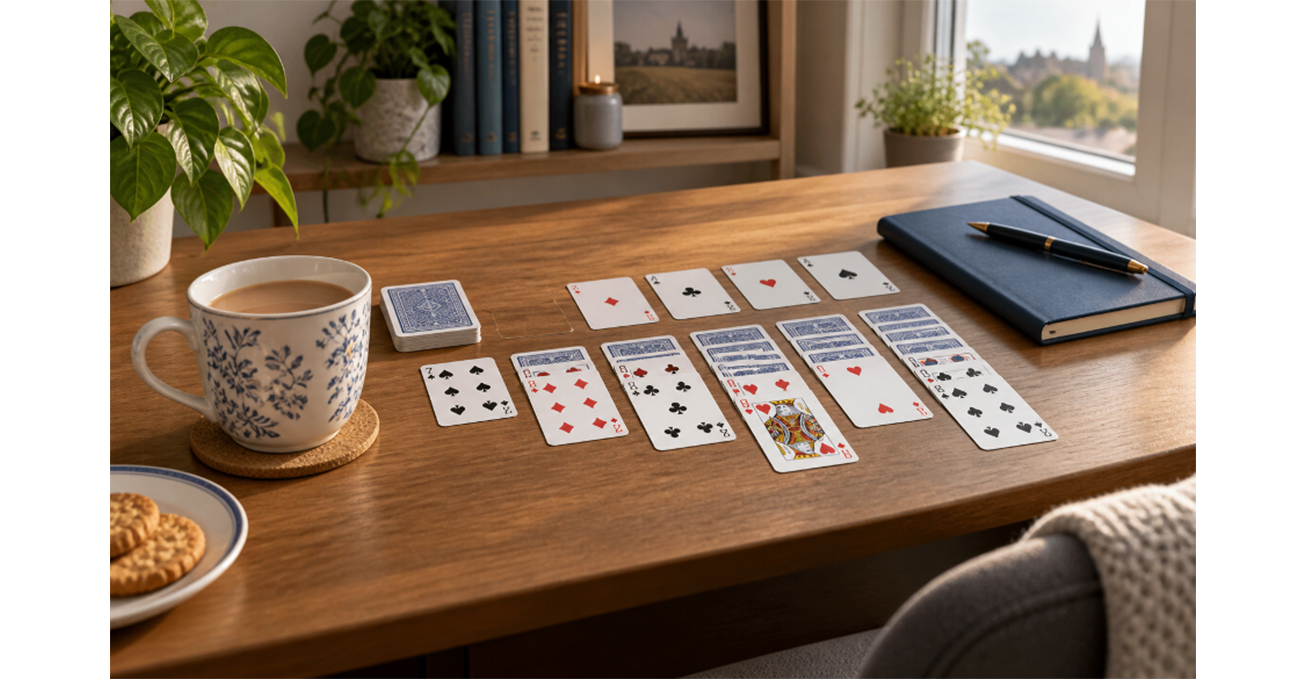
A spare moment between appointments is enough to open a card game, but not necessarily to finish one. Instead of chasing a quick win, try a smaller challenge: look at the opening board and explain what your next move would actually change.
You can use a deal on PlaySolitaire to try this with Klondike, the familiar version with seven columns. The aim is to build four foundations from ace to king, one for each suit. On the main board, cards descend in alternating colours. Those simple rules create choices that deserve a second look.
Look beneath the card you can move
Imagine two black sixes are available and either could move onto a red seven. One six has a face down card underneath it. The other is the only card left in its column.
Both moves are legal, but they do different jobs. Moving the first six exposes a new card, giving you information and potentially another move. Moving the second empties a column. In Klondike, that space accepts only a king or a correctly ordered sequence headed by one.
Before choosing, look for a king you could actually move. An empty column is not automatically useful. Nor does revealing a card guarantee a better outcome: you do not know what lies underneath. The point is to identify the tradeoff, not pretend there is a winning formula.
Check the cards you would uncover next
Suppose moving that king would reveal another hidden card in its original column. Now the empty space has a clear purpose. You can trace a short chain: move the six, relocate the king, turn over the newly exposed card.
If no king is available, revealing the card beneath the other six may be the more useful experiment. Pause after the reveal and reassess. A move that looked promising a moment ago can change once another card becomes visible.
Give a short session a smaller goal
For someone fitting a game around a working day, this approach offers a stopping point that does not depend on completing the deal. Compare two moves, make one, then note whether it opened a useful column or revealed something new.
There is no need to turn the exercise into a claim about productivity or brain training. It is simply a way to enjoy the decisions within solitaire rather than judging every attempt by the final result. When the next appointment approaches, an unfinished board is a perfectly reasonable place to stop.