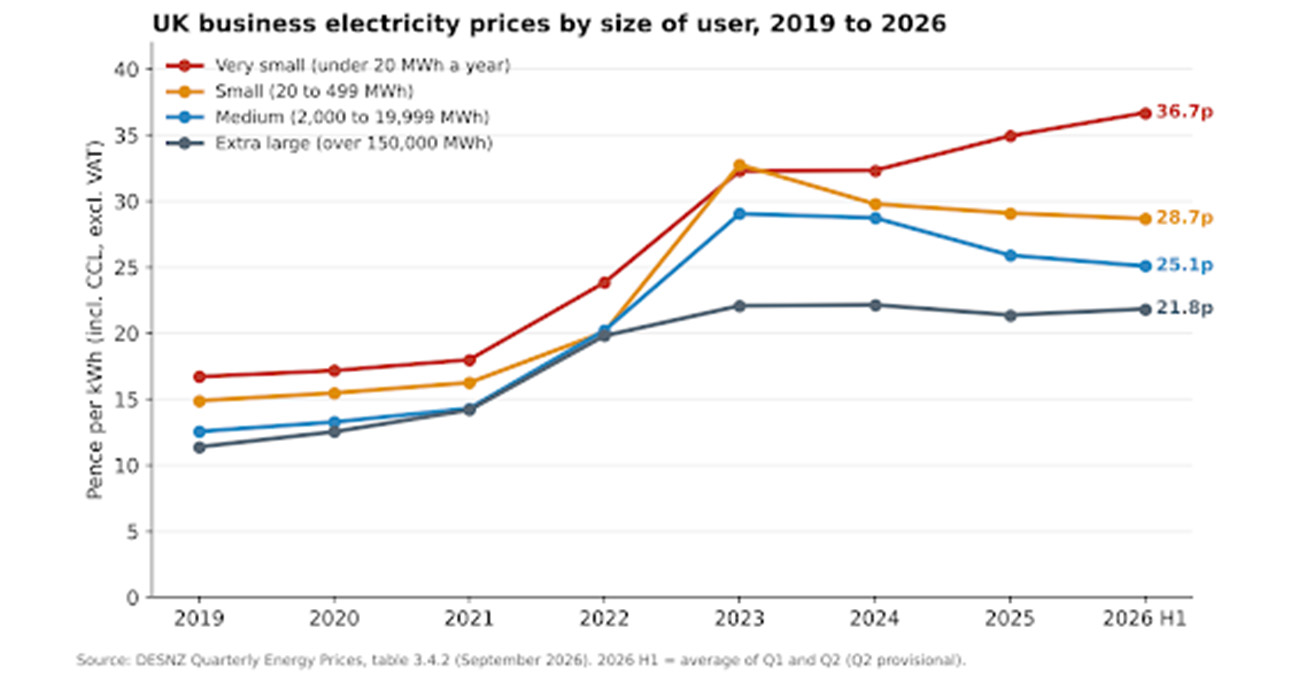
The smallest firms in the UK are paying more for each unit of electricity than at any point in the government’s records, in cash terms, even as prices for larger businesses have eased. And the gap between the two is widening.
Businesses in the government’s “very small” band, those using under 20,000 kWh of electricity a year, paid an average of 36.7p per kWh in the first half of 2026. That figure, from the Department for Energy Security and Net Zero’s quarterly non-domestic energy prices, includes the Climate Change Levy but not VAT. In 2019 the same group paid 16.7p. That is a rise of 120% in seven years.
The band covers a large share of the country’s smallest businesses: many independent shops, salons, small offices and studios fall inside it.
What stands out is the direction of travel since the 2022 to 2023 price shock. For most business users, prices peaked in 2023 and have been coming down. Firms in the small band (20,000 to 499,000 kWh a year) paid 32.8p per kWh in 2023 and 28.7p in the first half of 2026, a fall of 12%. Medium-sized users went from 29.0p to 25.1p. The largest users of all, those consuming more than 150,000 MWh a year, paid 21.8p.
The very small band went the other way. Its average was 32.3p in 2023, 34.9p in 2025 and 36.7p in the first half of 2026. The provisional figure for April to June 2026 alone was 38.4p, the highest quarterly number in the series.
Put side by side, the smallest users now pay about 68% more per unit than the very largest. In 2019 the difference was 47%. Compared with the small band just above them, the gap has grown from 1.8p per kWh in 2019 to 8.0p today.
What that means in pounds
For a business using 15,000 kWh a year, roughly the level of a small shop or office, the 2019 average works out at about £2,506 a year before VAT. At the average for the first half of 2026, the same usage costs about £5,504. That is close to £3,000 a year more for the same amount of power.
Few small businesses have seen their takings rise by anything like that over the same period, which is why electricity has moved from a background overhead to one of the bills owners now watch most closely.
Why the smallest firms pay the most
The government’s figure is an average: the total that businesses in each band spend, divided by the units they use. That means it includes standing charges and other fixed costs, not just the unit rate. A fixed daily charge spread over a small number of units adds far more to each kWh than the same charge spread over a factory’s consumption.
Buying power matters too. A large firm negotiates terms across many sites, often with a specialist buying team. A small business usually holds a single contract and may only look at it once every year or two. Ofgem’s reviews of the microbusiness market have repeatedly found that firms left on deemed or out-of-contract rates, which apply when a fixed deal ends and nothing new is agreed, tend to pay more than those on agreed contracts.
Where to start
Because the government figures are averages across thousands of contracts, the rate on any single bill can sit well above or below them. The only way to know where yours sits is to compare business electricity prices against your current unit rate and standing charge before the renewal window closes.
Three numbers on the latest bill or contract do most of the work: annual consumption in kWh, the unit rate and the daily standing charge. Add the contract end date and the notice period, because many fixed deals must be cancelled in writing weeks before they end. Since October 2024 Ofgem has also required suppliers to tell small business customers how much of their bill goes to any broker that arranged the contract, which makes it easier to see what is being paid for.
Usage is the other lever. A smart or half-hourly meter shows what the premises draw overnight and at weekends, when nobody is there. Fridges, chillers, water heaters, signage and equipment left on standby often account for a surprising share of that base load, and timers or simple switch-off routines cost little to set up.
For lighting, replacing older fittings with LEDs remains one of the quickest paybacks in a small unit, particularly in shops where lights are on all day.
DESNZ also notes that it revised the very small series from late 2024 after work with data suppliers, and that further revisions are possible, so the latest quarters should be read with some care. The overall pattern, though, has held for three years.
None of this changes the wider market, and the gap in the figures suggests small firms are carrying more of the cost of the last few years than their larger counterparts. But at 36.7p a unit, every kWh not used and every penny shaved off the rate is worth more to a small business than it was before.
The next set of figures, covering July to September 2026, is due from DESNZ on 17 December.
How we worked it out: prices are from DESNZ Quarterly Energy Prices table 3.4.2 (published 29 September 2026), in pence per kWh including the Climate Change Levy and excluding VAT. Figures for 2026 are the average of the first and second quarters; the second quarter is provisional. The 15,000 kWh example multiplies that usage by each period’s average price and is an illustration, not a quote.