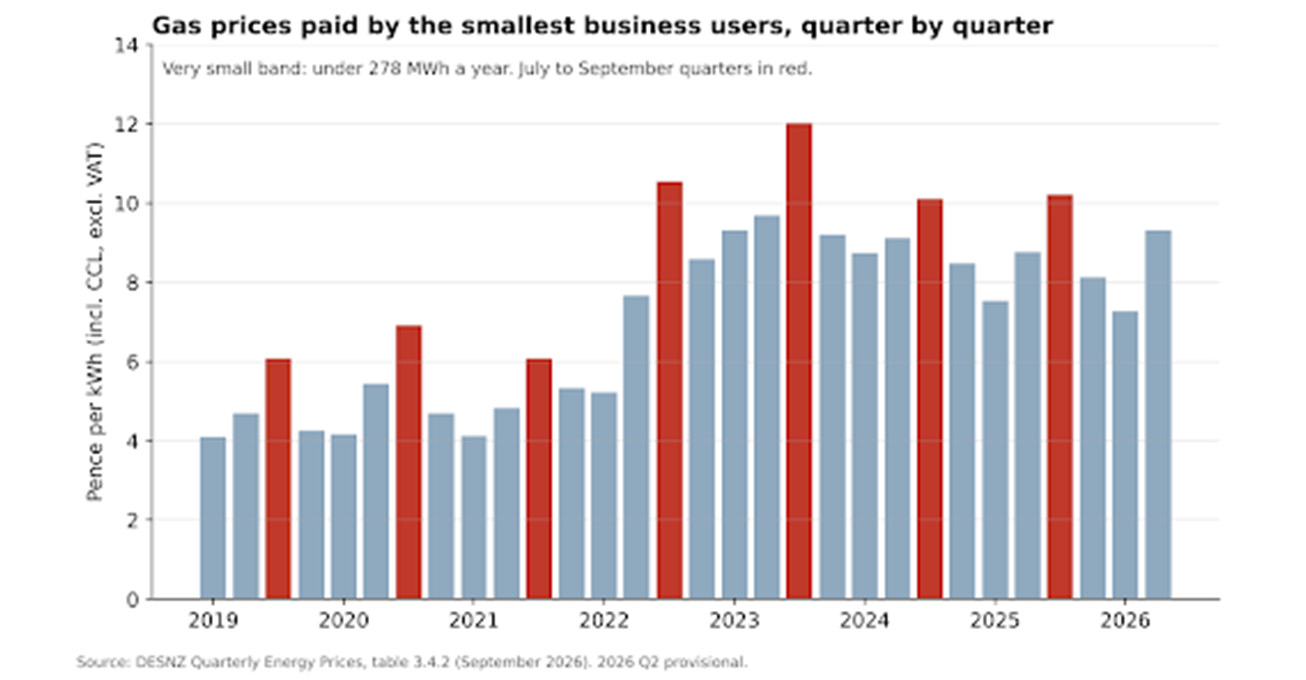
Small firms that use gas mainly for heating pay noticeably more for each unit in the warmest months of the year. Government figures show that for the smallest business gas users, July to September has been the most expensive quarter of every year since 2019.
The Department for Energy Security and Net Zero publishes the average price businesses pay for gas, split by how much they use. Its “very small” band covers sites using under 278,000 kWh a year, which takes in most cafés, restaurants, pubs, salons, workshops and offices with gas heating.
In the third quarter of 2025, very small users paid an average of 10.2p per kWh, including the Climate Change Levy but before VAT, according to the DESNZ quarterly non-domestic price tables. In the final quarter of the same year the figure was 8.1p. Gas in the summer quarter cost 26% more per unit than gas used from October to December.
The pattern repeats every year. In 2023 the summer quarter averaged 12.0p against 9.2p in the autumn quarter that followed, a difference of 31%. Back in 2019, before the energy crisis, it was 6.1p against 4.3p, a 43% difference.
It is not the gas that gets dearer
The reason has more to do with the shape of a small business’s bill than with the gas market. The government’s figure is the total that businesses in the band spend, divided by the units they use. Part of every bill is a daily standing charge, paid whether the boiler is on or not.
In winter that fixed charge is spread across a lot of gas. In summer, when heating is off and the only use is hot water or a kitchen, the same charge is spread across far fewer units, so each kWh carries more of it. For a business with a cooker and little else running in July, the standing charge can be a large part of the summer bill.
Larger users are much less exposed to this, because fixed charges are a small share of what they spend. Across the year, very small users paid an average of 8.3p per kWh in the first half of 2026. The small band, 278,000 to 2.8 million kWh a year, paid 4.8p, and large users 4.0p. The smallest firms pay roughly 1.7 times the small-band price and more than twice what large users pay.
The bigger picture
Prices for the smallest gas users have come down from the peak but not back to where they were. The very small average was 4.5p per kWh in 2019, 9.7p in 2023 and 8.3p in the first half of 2026: 15% below the peak but still 83% above 2019.
For a restaurant using 60,000 kWh of gas a year, the 2019 average works out at about £2,709 before VAT. At the first-half 2026 average, it is about £4,970.
What this means when choosing a deal
Because a low-use site pays so much of its bill through the standing charge, the headline unit rate on its own can be misleading. That is why it pays to look at both numbers when you compare business gas suppliers: on a site that burns little gas for half the year, a deal with a slightly higher unit rate but a lower daily standing charge can work out cheaper over twelve months.
As an illustration, take a café using 20,000 kWh a year. A deal at 6.0p per kWh with a 60p daily standing charge costs about £1,419 a year. A deal at 6.5p with a 20p standing charge costs about £1,373, even though its unit rate is higher. On a bigger site using 100,000 kWh, the order flips, and the lower unit rate wins comfortably.
A few other points are worth checking, particularly for seasonal businesses:
Meter readings. Estimated bills are usually based on past use, so a winter-heavy estimate can overshoot badly in summer. Sending actual readings at the change of season keeps bills closer to reality and avoids a large catch-up later.
De minimis use. HMRC treats business gas use below 145 kWh a day, or 4,397 kWh a month, as de minimis. Supplies below that level are charged the 5% reduced rate of VAT and are not subject to the Climate Change Levy. Some very small sites fall under the threshold in the summer months, so it is worth checking how the supplier is applying it.
Boiler servicing. Summer is the cheapest time to have the boiler and controls looked at, before the heating season starts. Timers and thermostats that have drifted out of step with opening hours are a common source of wasted gas.
Contract dates. Many fixed deals need written notice weeks before they end. A contract that rolls over on to out-of-contract rates in the autumn will carry those rates into the months of heaviest use.
None of this changes the underlying price of gas. But for the smallest users, how the bill is built matters almost as much as the market it is built on.
How we worked it out: prices are from DESNZ Quarterly Energy Prices table 3.4.2 (published 29 September 2026), in pence per kWh including the Climate Change Levy and excluding VAT. The 2026 figure is the average of the first and second quarters; the second quarter is provisional. The restaurant and café examples are illustrations using those averages and made-up tariffs, not quotes.