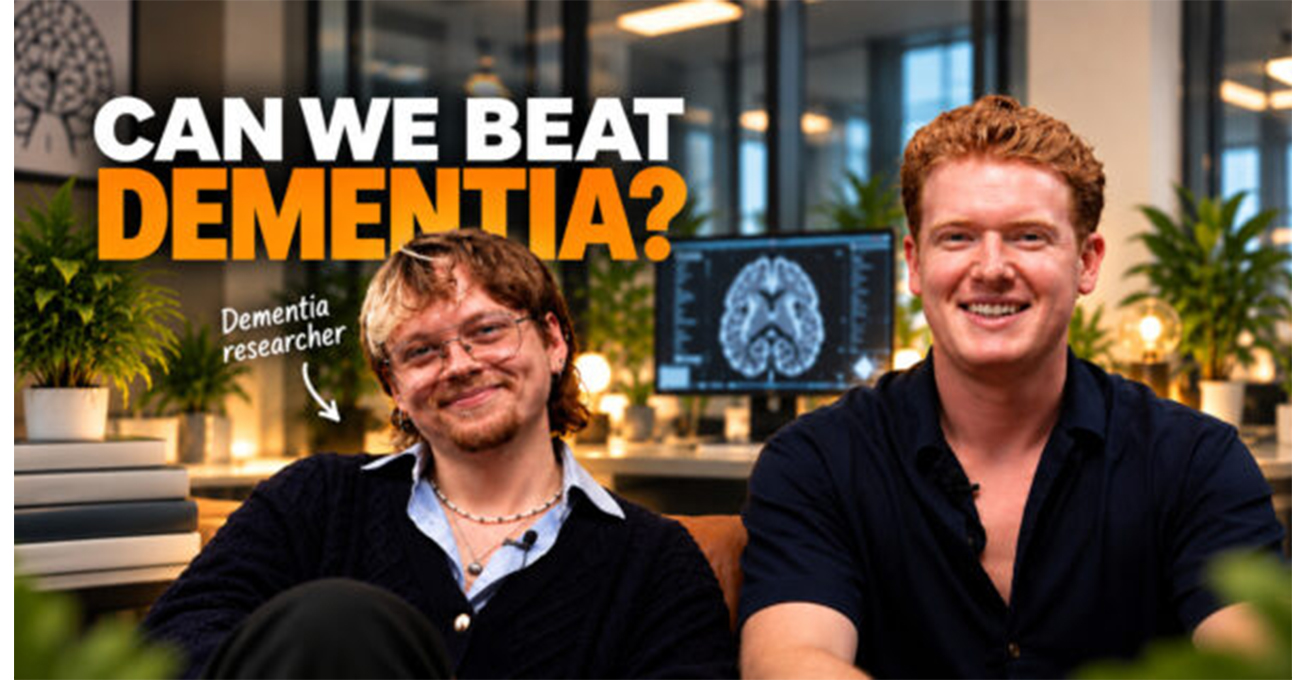
A popular UK neuroscientist has urged caution over the excitement surrounding breakthroughs in the treatment of Alzheimer’s, warning that new drugs should not be “overhyped” despite research accelerating at a “rapid pace”.
Toby Curless, who has made it his mission to explain the complex science of dementia to a general audience, has more than 100,000 followers on TikTok and his posts have been liked 1.6 million times.
He says recent advances in understanding, diagnosing and treating Alzheimer’s give genuine grounds for optimism, but the benefits offered by new treatments remain modest and researchers still have fundamental questions to answer about the disease.
Speaking on the If You Can podcast ahead of World Alzheimer’s Day today (Monday 21st Sept), Curless said scientists were now working in an “incredibly exciting space” but cautioned against allowing promising trial results to create unrealistic expectations of what current treatments can achieve.
Toby Curless, known online as Toby the Neuroscientist, said: “I think it’s important that we don’t overhype some of these findings.”
Discussing recent treatment trials, he said there remained debate within the scientific community about how meaningful the benefits were for patients.
Curless, whose PhD is funded by Alzheimer’s Research UK, said: “There are people in the research community who don’t think that they are effective at all, because they don’t think that the benefit that you get from them is worth it.
“But the fact that we have treatments now that are targeting the disease and having an effect, albeit a modest one, is a really exciting step. Things are accelerating at a rapid pace at the moment.”
The interview is the latest episode of If You Can, hosted by 26-year-old British adventurer Louis Alexander.
The weekly podcast explores the doubts, setbacks and difficult decisions behind extraordinary achievements in sport, business, entertainment and life, with guests discussing the lessons they have learned from their experiences.
Both Curless and Alexander are young dementia campaigners and inspired by their grandfathers and fighting the disease in different ways – one through science, the other through adventure.
They discuss how advances are being made across several fronts rather than treatment alone, but asked about the prospect of a cure, Curless cautioned that there was still considerable work ahead.
He tells the podcast: “We are still quite some distance off what I think people would regard as a cure. But with technological advances, I think we’re in an incredibly exciting space.”
Curless’s own research examines the genetics and molecular biology of dementia, comparing the genetic and molecular make-up of brains affected by different forms of the disease with those of healthy people.
He hopes that identifying important differences could ultimately contribute to the discovery of new therapeutic targets and treatments.
The scale of the unanswered questions means Curless accepts that some may remain unresolved throughout his own research career. But rather than seeing that as a reason for pessimism, he describes it as part of what motivates him.
He tells the podcast, which aired last night on the eve of World Alzheimer’s Day, that there is a possibility that by the time he retires researchers could still be searching for some of the answers they want, but that he remains excited to go to work every day and try to solve them.
And his message was ultimately one of scientific progress.
He added: “Right this second, we as a global community have the best understanding of dementia and the diseases that cause dementia that we’ve ever had. And tomorrow we will know even more, and we will be one step closer to making that breakthrough.”