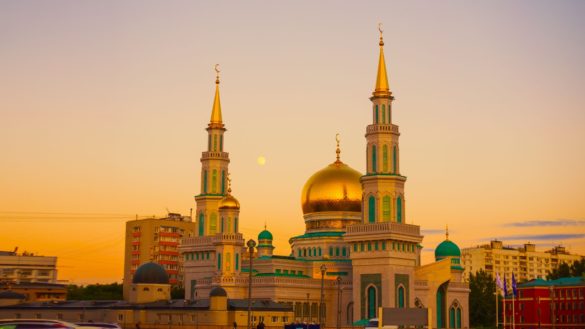
 Birmingham Central Mosque remains an almost unique institution in the UK not being aligned to any single school of Islam. Worshippers are any denominations are welcome to attend and indeed the congregation which during Friday prayers numbers upwards of 4,000 are drawn from all parts of the Muslim world. Pakistanis, Arabians, and Africans all mingle in its vast hall.
It has also the benefit of, unlike other prominent mosques, having been built and run entirely on the donations of its congregation. There is no foreign government sponsorship or backing from influential wealthy benefactors as there is at some other places.
History of the Central Mosque
Central mosque is the second purpose-built mosque in the United Kingdom. After initially raising the money to lay the foundations of the mosque, funds had run dry. There was the chance that the city council would sell the land off to another buyer if the mosque was not completed within two years. Meanwhile, tune into some truly ravishing UK Bingo. Thus the mosque trustees went to local communities for donations, both Muslim and non-Muslim. Soon enough, sufficient money was raised to pay for the building and completion of the mosque in 1969. The mosque was then officially opened in 1975 as the largest mosque in Western Europe.
What it is used for?
Since the mosque’s erection, it has become a focal point for the Muslim community. Over the years, Muslims have used the mosque for events, meetings, lectures, studies, and community and educational purposes. Many of the original founders of the mosque committee still make up the mosque management or are trustees of the mosque but as time has passed, many new innovations have been made as to how the mosque is democratically run using Islamic teachings as the basis for the equal representation of all members of the community. Thus, regular meetings, annual selection, and equal opportunities have meant that the running of Birmingham Central Mosque has been as efficient as possible over the decades.
The intricate design of the Mosque
The mosque itself has got two floors. On the first floor, there is a large main hall for prayers which can easily accommodate around 3000 worshippers at a given time. In addition, there is a Ladies’ gallery to occupy about 400 women. New contracts have recently been given to extend the ladies’ gallery as well as provide extra separate accommodation for visitors to the mosque who drop in to learn about Islam and Muslims. The ground floor is divided into two areas providing office accommodation, a community hall, an extensive Islamic library, educational classrooms, and a large school area which is used for prayers, assemblies, and other activities.
On special days like Eid, when demand is high, both the main prayer hall and school hall are used for prayers providing accommodation for 5000 people. On Eid day, there are five prayer services during which between 15,000 to 20,000 worshippers visit the mosque for the special services, and on Fridays, the gathering is 4,000 plus. This is excluding the frequent attendance of international visiting groups and mainstream media personnel.
The mosque has worked very closely with the media since its inception to represent the Muslim community of Birmingham as a diverse and united people. The BBC recently made two documentaries based on Birmingham Central Mosque including a Panorama special and the mosque has played a central role in newspapers, television, and radio on matters pertaining to the wars on Afghanistan and Iraq along with other issues.