
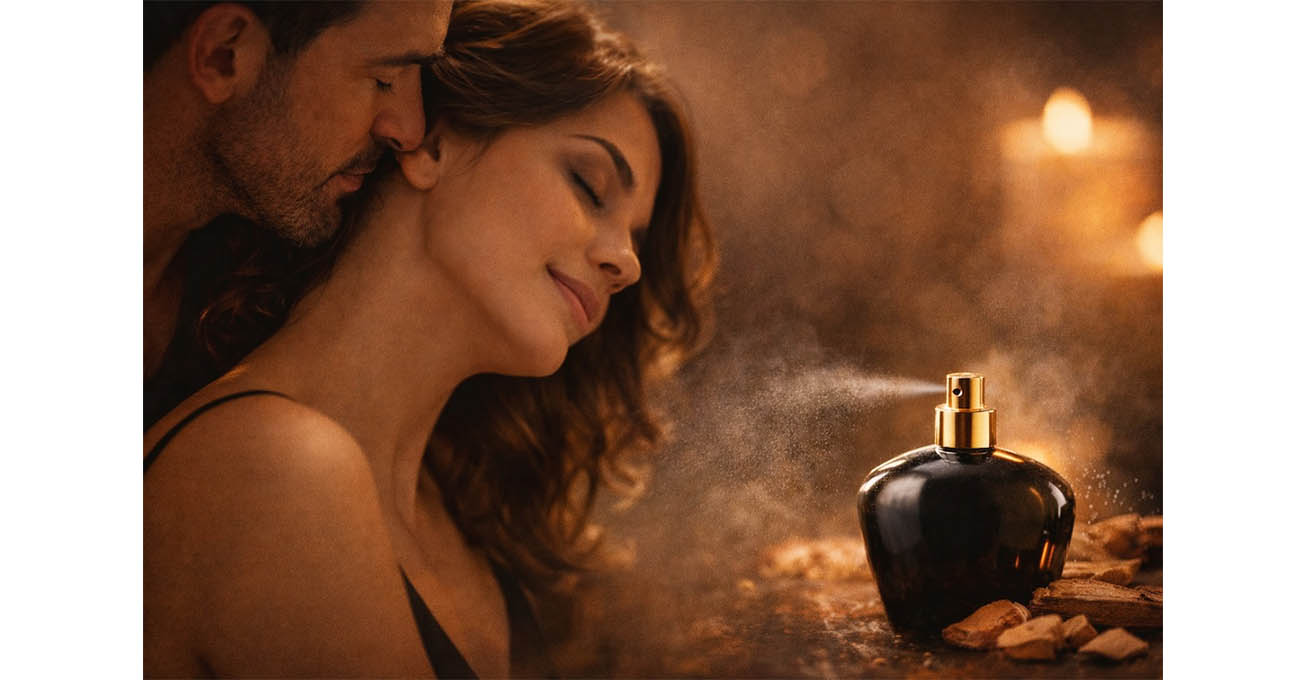
 With Valentine’s Day approaching, shoppers are rethinking traditional gifts in favour of something more personal — and more sensory. New data from NielsenIQ shows UK spending on fragrances rose by 11% year-on-year in the lead-up to Valentine’s Day, with £19 million spent on scent alone.
As consumers look for gifts that feel intimate rather than predictable, one trend is standing out on beauty shelves this February: pheromone fragrances.
You may have seen them online: sleek bottles promising mysterious allure, “magnetic attraction”, and a hint of something biological said to turn heads from across the room. But what exactly are pheromone fragrances, and do they offer anything beyond clever marketing claims?
Fragrance expert Jonny Webber from Perfume Direct explains more, along with his top picks for those wanting to give the gift of “magnetic attraction”.
Pheromones 101
Pheromones are chemical signals that animals use to communicate – most famously to attract mates. Humans, it turns out, aren’t deaf to chemical signalling. We do emit tiny amounts of certain compounds through skin and sweat, and some research suggests humans can subconsciously detect these cues.
But here’s the Rubik’s Cube of it all: the science is complicated. While some studies hint certain pheromone-like compounds – like androstadienone and estratetraenol – might influence mood or perception, there’s no definitive proof they make someone “fall in love” on the spot. Sorry, Cupid.
So, what are pheromone perfumes actually selling? They’re not magic bullet chemistry; they’re perfumes infused with specially selected compounds that might amplify natural body chemistry or enhance confidence – and scent plays a huge role in attraction anyway. While you shouldn’t expect a pheromone spritz to guarantee a Love Island-style coupling, there’s a more nuanced reason they’re trending.
Scent, Memory and Mood: Where the Magic Actually Happens
Here’s the bit you can bank on: scent is one of the most powerful triggers of emotion and memory. Ever caught a whiff of something and been transported back to a moment — childhood summer, first date? That’s neuroscience, not sorcery.
What’s often misunderstood in the pheromone conversation is that attraction through scent isn’t really about a single chemical compound – it’s about how fragrance interacts with memory, mood and personal skin chemistry. The olfactory system is directly linked to the brain’s limbic system, which controls emotion and memory, meaning scent can trigger feelings and associations far more powerfully than sight or sound. This is why certain fragrances feel instantly comforting, alluring or familiar without us quite knowing why.
Pheromone fragrances tap into this by pairing evocative base notes — amber, musk, vanilla — with targeted compounds that are designed to sit close to the skin’s chemistry. That combination can boost your mood, your confidence, and maybe even how someone perceives you — and that’s a far more credible kind of attraction.
These warmer, skin-like base notes are not accidental. Notes such as amber, sandalwood, musk and vanilla are frequently used because they sit close to natural body scent, creating what perfumers call a ‘second skin’ effect — where the fragrance feels less like something worn and more like something personal.
Science vs. Sizzle: What the Research Says
- Human pheromones exist, but context matters – social perception, personality, confidence and cultural cues all chime in alongside chemistry.
- Few peer-reviewed studies conclusively show pheromones trigger sexual attraction in humans alone – attraction is multifaceted and can’t be pinned on a single molecule.
- Placebo effects are real – if wearing a particular scent boosts your confidence because you believe it will, that’s not nothing.
- Research shows people are often subconsciously drawn to scents that feel familiar or comforting rather than overtly noticeable, meaning subtle, warm fragrances can be more effective in close personal settings than loud, attention-grabbing perfumes.
So no, a pheromone perfume won’t override free will, but it might tweak the chemistry of a situation in your favour, especially if you walk into a date feeling like a million quid.
Valentine’s With a Twist: How to Use Pheromone Scents in the Real World
Here’s where we lean away from wishful thinking and lean into strategy:
Match the moment
Choose fragrances with warm, inviting base notes — amber, sandalwood, vanilla — for intimate dinners; lighter florals and musk blends for daytime meetups.
Try: YSL Opium – a longstanding classic with deep sandalwood, amber and vanilla-like resin notes anchoring the dry-down.
Layer, don’t douse Subtlety wins. Spray pheromone perfume on pulse points — neck, wrists, inner elbows — where warmth helps diffuse the scent naturally.
Confidence is the real aphrodisiac
Whatever the science says, people are drawn to energy. If a scent makes you feel magnetic, that radiates — and others pick up on it.
A best seller: Tom Ford Black Orchid Unisex – a modern classic with amber, vanilla and sandalwood underpinning its complex floral-oriental heart, making it rich and sensual.
Pheromone fragrances aren’t a secret love potion — but they do sit at the intersection of psychology, chemistry and emotion, which is where real attraction tends to live.
In a world where Valentine’s can feel like a conveyor belt of clichés, choosing a scent that speaks to identity, mood and emotional resonance? Now that’s a story worth smelling.
So, this year, don’t just buy a bottle, buy something with these attributes that might just add that little extra to your Valentine’s Day.