
The UK continues to see a high level of new company formation in 2026, despite changes to the registration process and a more demanding compliance environment.
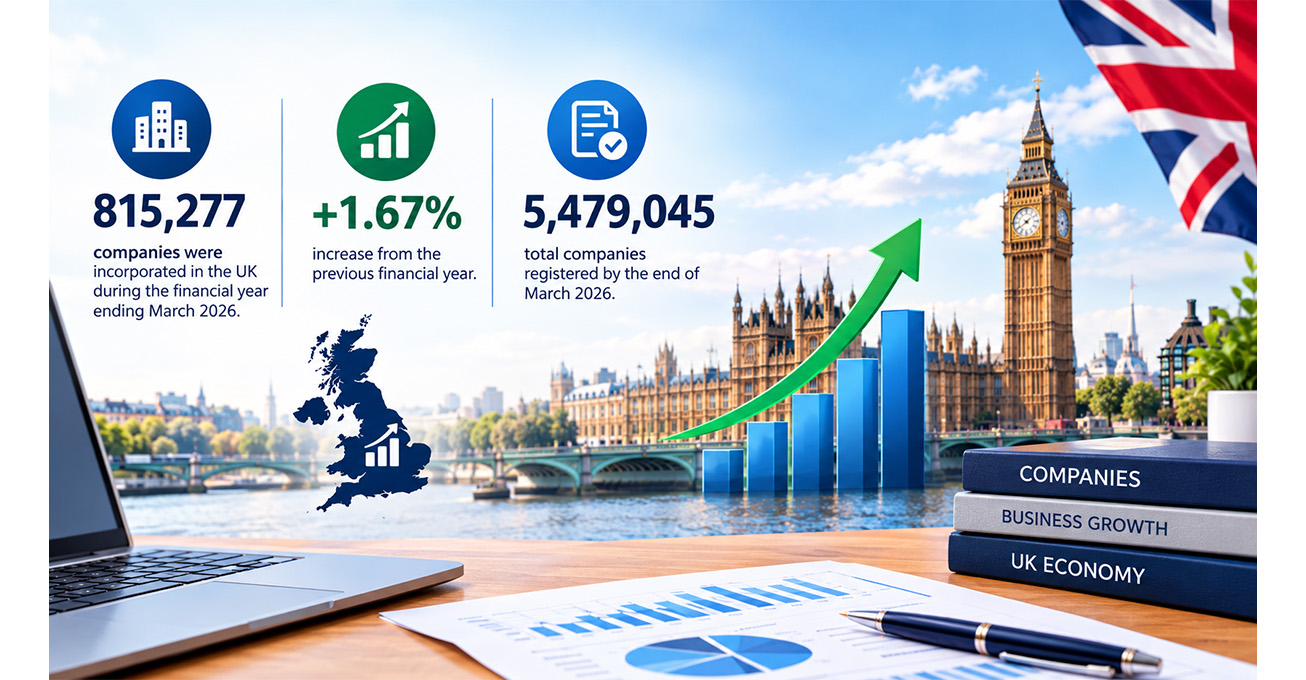
The latest Companies House figures show that 815,277 companies were incorporated in the UK during the financial year ending March 2026, up 1.67% from the previous financial year. At the end of March 2026, the total companies register contained 5,479,045 companies.
The figures provide an important snapshot of the UK’s business landscape. They also show that entrepreneurs are continuing to create companies at scale while Companies House introduces significant changes to identity verification, registration fees and the information companies must maintain.
For anyone considering a UK limited company formation, the 2026 data offers useful insight into the direction of new business activity and what founders need to consider before they set up a limited company.
More Than 815,000 Companies Were Incorporated in 2025-26
Companies House recorded 815,277 incorporations during the financial year from April 2025 to March 2026. This represented a 1.67% increase compared with 801,871 incorporations in the previous financial year.
The increase is notable because the period also included major changes to the company registration system.
The total number of companies on the register increased by 0.94% over the financial year, reaching approximately 5.48 million companies at the end of March 2026. At the same time, 787,120 companies were dissolved during the year, an increase of 8.31% compared with the previous financial year.
This means that company formation should not be viewed simply as a measure of the number of businesses operating successfully. Companies are continually being created and removed from the register, making incorporation statistics a measure of business activity rather than a direct measure of business survival.
Q1 2026 Saw More Than 200,000 Incorporations
The first quarter of the calendar year 2026 was particularly active.
Between January and March 2026, Companies House recorded 204,612 incorporations. That was 10.67% higher than the previous quarter, although 3.08% lower than January to March 2025.
There were also 190,836 dissolutions during the same quarter.
The figures demonstrate that the UK continues to experience substantial movement on the company register. More than 200,000 companies were incorporated in just three months, while a similarly large number of companies were removed from the register.
For prospective founders, this provides useful context: registering a company is only the beginning. Maintaining accurate company information and meeting ongoing filing and compliance obligations remain important after incorporation.
The Second Quarter Continued to Add New Companies
The latest available quarterly data strengthens the picture.
Between April and June 2026, Companies House recorded 192,287 company incorporations. The company’s register grew by 37,339 during the quarter, reaching 5,516,377 companies at the end of June.
Monthly incorporation figures were:
| Month | Incorporations |
| April 2026 | 67,059 |
| May 2026 | 62,091 |
| June 2026 | 63,137 |
| Q2 total | 192,287 |
The figures indicate that company formation remained substantial during the second quarter, even though monthly numbers moved up and down.
It is also important to distinguish company incorporations from broader business creation statistics. The Office for National Statistics reported 79,325 business creations in Q2 2026, based on businesses entering the Inter-Departmental Business Register. That was 2.2% higher than Q2 2025.
These are different datasets with different definitions, so the figures should not be directly combined. Companies House measures activity on the companies register, while the ONS measure covers business creations recorded in the IDBR.
Private Limited Companies Remain the Dominant Company Type
One of the clearest long-term patterns in the Companies House data is the importance of private limited companies.
Companies House reports that private limited companies have represented more than 95% of corporate bodies on the register for the past 10 years.
That helps explain why the phrase “set up a limited company” remains relevant to so many new business owners.
A private limited company can provide a formal corporate structure for trading, holding assets and entering commercial agreements. However, incorporation also creates continuing responsibilities, including maintaining company information and submitting the required documents to Companies House.
Founders therefore need to consider more than the initial registration process when deciding whether a limited company structure is suitable for their business.
2026 Has Brought Important Changes to Company Formation
The headline incorporation figures do not tell the whole story. The process of forming and maintaining a company has changed significantly.
One of the most important developments is mandatory identity verification.
Companies House introduced identity verification as a legal requirement from 18 November 2025 under reforms associated with the Economic Crime and Corporate Transparency Act 2023. The requirement is being phased in over a 12-month transition period.
New directors need to verify their identity when incorporating or being appointed to a company. Existing directors and people with significant control are being brought into the process during the transition period.
For someone planning a UK limited company formation in 2026, identity verification is therefore an important part of understanding the current registration environment.
Companies House also increased incorporation and registration-document fees on 1 February 2026.
This is relevant when comparing the total cost of formation. A search for cheap company formation should not focus exclusively on an advertised headline price. Founders should also understand which government fees, registration requirements and ongoing obligations apply.
What a Registered Address Means in 2026
Another important consideration when founders set up a limited company is the company’s registered office.
GOV.UK states that a company must have a registered office address and registered email address when it is set up. The registered office must be a physical address in the UK and must be in the same country in which the company is registered. It must also be an “appropriate” address where company correspondence can reach someone acting on behalf of the company and where delivery can be acknowledged.
A Royal Mail PO Box cannot be used as a registered office address, including similar services from other companies.
This makes the choice of address more significant for founders who do not want to use their residential property as the company’s public registered office.
Companies House confirms that the registered office address appears on the public register. GOV.UK also explains that a company can use another address, such as an address provided by an accountant, solicitor or agent, where appropriate requirements are met.
For international entrepreneurs and businesses operating remotely, a compliant UK virtual address can therefore be relevant, provided the address being used satisfies the legal requirements for the company’s registered office.
The important point is that an address should not be selected simply because it looks professional. It must meet the applicable Companies House requirements.
Cheap Company Formation Does Not Mean Ignoring Compliance
The growth in incorporations also highlights an important distinction between the cost of creating a company and the cost of operating one.
Entrepreneurs searching for cheap company formation may naturally compare registration prices. However, the lowest initial cost does not necessarily represent the complete cost of establishing and maintaining a company.
Before incorporation, founders should consider:
- The Companies House registration fee
- Identity verification requirements
- The registered office address
- The company’s registered email address
- Appropriate SIC codes
- People with significant control
- Company records and filing obligations
- Corporation Tax requirements where applicable
- Ongoing confirmation statement and accounts obligations
GOV.UK confirms that when registering a company, founders need to provide an official address and choose a SIC code identifying what the company does.
The current online Companies House registration service costs £100, according to GOV.UK, and companies are usually registered within 24 hours when using the online service.
This provides a useful benchmark for anyone assessing the total cost of formation in 2026.
International Founders Are Part of the Wider UK Company Formation Picture
The requirements surrounding company addresses are particularly relevant to founders who operate internationally or work remotely.
A company needs an appropriate registered office address in the relevant UK jurisdiction. The address is publicly available on the Companies House register.
That means a founder who works from home may want to consider whether they are comfortable having their residential address appear publicly as the company’s registered office.
A UK virtual address can provide an alternative where the underlying service and address meet the relevant legal requirements. For international founders, this can allow the company to have a UK correspondence and registered-office presence without automatically making a personal residential address the company’s public registered office.
BusinAssist is one business supporting entrepreneurs with UK company formation and business address requirements, but the legal requirements themselves come from Companies House and GOV.UK rather than from individual service providers.
What the 2026 Data Tells Us About New Businesses
The latest figures reveal several important trends.
First, company formation remains substantial. More than 815,000 companies were incorporated during the financial year ending March 2026, while nearly 5.5 million companies were on the register at the end of that period.
Second, the volume of incorporations should be considered alongside dissolutions. More than 787,000 companies were dissolved during the same financial year.
Third, the process of forming a company is becoming more structured. Identity verification is now being phased in as a legal requirement, while Companies House has also increased its fees and continues to strengthen the information held on the register.
Finally, the registered office remains an important part of the incorporation process. It must meet specific requirements, and the address is publicly visible on the Companies House register.
Looking Ahead
The latest Companies House statistics suggest that the UK remains a highly active environment for company formation in 2026.
Although quarterly incorporation figures fluctuate, hundreds of thousands of companies continue to enter the register each quarter. At the same time, reforms are changing what founders need to do when establishing and maintaining a company.
For anyone planning to set up a limited company, the key lesson from the 2026 data is that incorporation is no longer simply about submitting a registration application. Founders need to think about identity verification, accurate company information, registered office requirements and continuing compliance from the beginning.
With the latest Companies House figures showing more than 815,000 incorporations during the 2025-26 financial year, the demand for UK company structures remains significant. For new founders, understanding the official requirements before registering can make the process clearer and help ensure that the company starts with the right information and arrangements in place.