
From packing potatoes on the factory production line to being promoted to a management role, business improvement officer Ronnie Wilkinson has enjoyed great success working for the UK’s largest potato supplier, Branston. Here he explains his progression, his role in ‘talent spotting’ others and his advice for those considering a career in the food business…
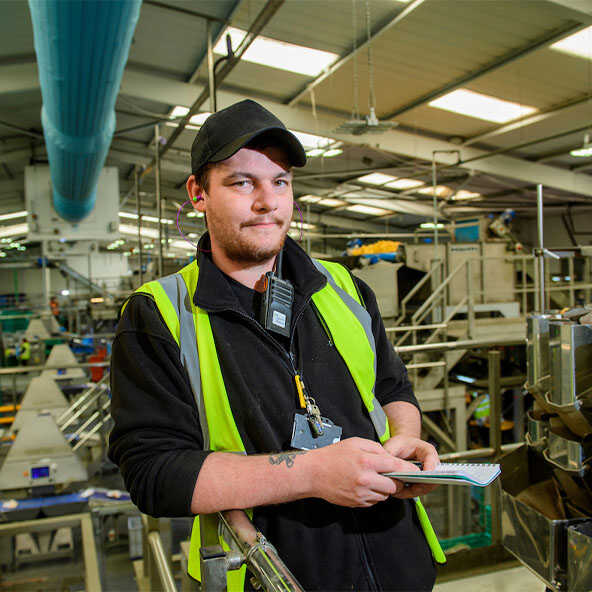
Music fan Ronnie has enjoyed a number of roles since he joined Branston in 2012. He is based at the Lincoln site, just outside the village of Branston. The company handles 350,000 tonnes of potatoes every year.
Tell us about your early working life
I started working behind the scenes at music festivals after my mum launched a recruitment agency supplying staff to events. I’d started out as a trainee car mechanic but wasn’t really happy and was advised at a careers event to choose a job that I would enjoy.
I loved music and the festival work at places like T in the Park and Glastonbury was great – we were putting out barriers and looking after crowd health and safety. It was access all areas and I saw the likes of Kasabian and the Red Hot Chili Peppers.
How did you go from music festivals to working at Branston’s potato factory?
My personal circumstances changed, meaning it wasn’t possible to be on the road six months a year, and I realised that I needed a local job. I applied to be a production line operator at Branston and thought I would see how it went.
I was packing and stacking on the lines – it was hard, physical work but it really suited me. I was quite fit back then – I’m not now! – and I was always at the gym. I realised that I was getting paid to do something I enjoyed and that kept me fit. I was really into working and keeping my mind healthy – when you’re busy you stay mentally healthy, so I liked that.
You only did that job for a year before being promoted. What happened?
The company asked if I was mechanically minded and interested in the machinery. It was a bit different back then, as we had to fix our own machines, so I jumped at the chance and got some training.
I coped really well and enjoyed it and I think the managers saw something in me. The production manager approached me, and she asked if I was interested in a vacancy for a team leader as they knew that I’d got supervisory experience.
So I started off in team leader training and doing some production planning, and from there it pretty much became a management world for me, really.
How did your career progress from there?
Within a year I’d had three different jobs and three different training patterns. At Branston, it’s like talent spotting – if they see your potential for doing other jobs, they will support you. It’s a progressive atmosphere and the company is very adaptive.
It’s about the passion you have too. Like any job, some people might not really be interested but those that want to do well for themselves can progress here.
I became a production team leader and was also a technician because of my mechanical machinery experience. After four years the company had a restructure – they had invested a lot of money in new machinery – and separated the roles. I chose to stay with team leading because I enjoyed working with people and helping them to develop.
How did Branston support you with training?
I was learning a great deal in the job and then my operation manager asked me how I wanted to progress further, as part of our appraisal objectives. I wanted to move up to an operation manager role as it covers everything and he advised me to get some engineering knowledge.
The company put me and other area leaders on a year-long course to gain a food manufacturing excellence diploma. I learnt how to use ‘lean’ techniques, which increase production efficiency, and continuous improvement methodology at Mansfield’s Vision West Nottinghamshire College.
We learnt leadership skills including how to run meetings, lead projects, 5S manufacturing methods – everything we needed to do our jobs better.
It helped me to really step up in my role – I could put what I’d learned into practice at Branston.
Describe your current role and what you aim to do next
I am now a business improvement officer but I am also responsible for the use of continuous improvement to drive performance and I create training plans for team members.
The training side became really important during the pandemic because we had to train people across a range of roles really quickly. It made us stronger in terms of planning and aiming to be one step ahead in case anything like that happens again.
Now I’m hoping to achieve the operations manager role. I’ve got a lot of work to do – I want to train and develop myself to move faster with progress. Obviously Covid didn’t help as it put a two-year gap on everything, but the company is very supportive.
What is your proudest achievement?
It’s seeing people flourish and develop into different roles. We’ve got a shift manager who was exactly the same as me and about six years ago I mentioned his name to the production manager at the time, saying he was a really hard worker and that he wanted to develop. He’s gone on to become a team leader.
I also have a trainee working with me who is going to learn everything I know and progress – and then she can train someone else to do her job.
What does the future hold as Branston continues to develop and introduce new products and machinery?
The crucial thing for me is about us being adaptive regarding sustainability and the environment, looking at the importance of recycling and being carbon neutral and how the machinery we use can make our potato packaging fully recyclable. Although I believe one of the issues is around human behaviour and what customers do with food packaging at home.
We have seen major changes in the last decade, with more than £10m invested in at least ten different types of machinery. We are trying to invest in a sustainable future – for example, we are considering the move from plastic to paper and the machinery we would need to do that. Customers are asking for that as it’s easier to recycle paper.
Any advice for someone setting out on the same route as you?
Definitely do something you enjoy – find the right job for you that you can be passionate about. Even if you’re starting at the bottom, aim to go as high as you can. It may take some time but persevere and set your mind to it and you will get there.