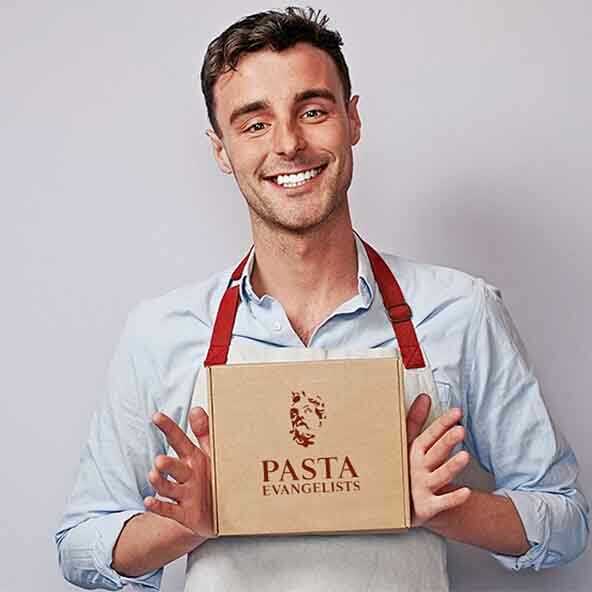

Finn Lagun is Co-Founder & CMO of Pasta Evangelists, the UK’s leading fresh pasta company. He is a food fanatic and wants to convert people in Britain and beyond to a new renaissance in pasta. Based in London, Pasta Evangelists was acquired by Barilla Group in 2021 for a reported £40m.
- Tell us a little bit about your business…
Pasta Evangelists is on a mission to evangelise real, fresh pasta. Our aspiration is to become the authority and category leader in fresh pasta and sauces, first in the UK and then internationally. We launched the business in 2016, initially selling pasta in London through our website, pastaevangelists.com. Today, we serve the whole of the UK, delivering boxes of the freshest, artisan pasta and authentic sauces to homes across the country. We’ve also launched other sales channels, enabling our customers to shop with us through the likes of Deliveroo, Ocado and M&S. In 2021, we opened our first restaurant venture, the Pasta Evangelists pasta bar in Harrods, the iconic Knightsbridge department store.
- How did you get into the industry?
I grew up in Newcastle, where my dad is a well-known (and occasionally eccentric) restaurateur. He veered from one concept to the next, from classical French to Italian and even Vietnamese, so I spent a lot of time eating different foods from across the world as a child and teenager, as well as observing just how meaningful food, when done well, can be for people. In this way, I’ve always loved food, restaurants and gastronomy. I moved to London when I was 21 and began working in start-ups – initially for a dry cleaning and laundry delivery company. I then had a short stint at Amazon, which, whilst an amazing place to work in so many ways, simply felt too big an enterprise for me to make my mark. I left, briefly launching a D2C vegan start-up, offering newcomers to plant-based eating a box with everything they needed to get started. A few weeks in, by serendipity I met my now co-founders Alessandro and Chris, who were in the process of setting up Pasta Evangelists. I thought the idea was far better than mine, so I packed up the plant-based paraphernalia in favour of pasta and, from a dark basement in West London with no internet, we got Pasta Evangelists underway.
- What are the biggest opportunities and challenges in your industry?
In FMCG, a growing consumer appetite for premium goods presents a huge opportunity for businesses. Many categories (including pasta, which the raison d’être for Pasta Evangelists) have remained stagnant for decades, seeing little or no innovation. At a time when consumers are increasingly looking for products with clear provenance, fewer artificial ingredients and more aspirational brand identities, it is a great time to bring a premium, clearly differentiated offering to market. Fifteen years ago, Schweppes, for example, was the clear incumbent in tonic water and few would have imagined that would change. Today, though, Fever Tree is the category leader in the UK, with a market capitalisation of over £2.5bn. In its ascendancy, Fever Tree emphasised the importance of giving gin drinkers an altogether better product to pair their spirit with. This resonated, and similar ‘premiumisation’ success stories (the rise of craft beer springs to mind) emerged in tandem.
That the UK has one of the world’s highest internet penetration is also a huge opportunity: Brits have embraced the rise of e-commerce wholeheartedly, meaning entrepreneurs can launch their own D2C businesses with little capital, bypassing complex, more traditional routes to market like retail. Dark kitchens, too, offer food and beverage businesses a new route to market, with companies launching digital brands on platforms like Deliveroo, UberEATS and JustEat. In London, the emergence of a new ‘fifteen-minute grocery’ services like Weezy and Getir, backed by massive private equity investments, provide yet more opportunities for disruptive food brands to access customers in new places.
In terms of challenges, uncertainty stemming from the pandemic is clearly one. Physical retail and restaurants worry about potentially shutting up shop yet again, whilst companies with a significant D2C channel, like ours, fret that, in a post-pandemic world, customers might abandon home delivery services in droves when they are able to eat out again. Truth be told, though, I think any exodus of customers from home delivery brands will be temporary: the reasons home delivery was a growing category before the pandemic, i.e. convenience in an increasingly time poor world, will make themselves felt again as the population returns to working arrangements closer to those seen before the pandemic.
- How would you describe your leadership style?
I would describe my leadership as collaborative and consensual (as opposed to adversarial), upbeat and hands-on. If my team encounters a problem, I like to help them find the solution – to be in on the action. I try to be as approachable as possible: I am very informal and do my best to get to know everyone working in the business. I believe far more in carrots than sticks: when employees feel fearful or anxious in the workplace, this simply compounds problems they, or the business, may be encountering. From my perspective, people – myself included – do their best work when they feel enthused, full of energy, optimistic and excited about that work. Leaders who still think fostering a culture of fear is valuable have no place in the modern workplace.
- How do you get the most out of the people who work for you?
It is important employees understand the context of the work they carry out: why they are doing it and the value their work creates. I therefore give P&L responsibility to many team members and encourage them to run their respective business functions (or marketing channels) as though they were their own businesses.
We have regular brainstorming meetings where the next ‘big idea’ is just as likely to come from an intern as it is a member of management: this again ties into the importance of an informal culture where all team members feel confident enough to share their thoughts. This isn’t easy, and we don’t always get it right, but the value of breaking down hierarchal structures can be profound.
My personal leadership style is quite evocative: I like to paint a picture, usually with language, of the destination for my team. I like them to feel what we are trying to achieve. I don’t like monotonous slides or endless droning about KPIs, so I don’t expect these to excite my team either. Instead, I try to communicate objectives with passion and enthusiasm whilst recognising that many successes can’t be understood through a spreadsheet-centric view of the world.
I also try to be conscious, in every interaction I have with my team, of different personality types. In my opinion, a good leader does not expect his or her line reports to adapt their behaviour to suit the leader – rather, the leader themselves adapts their approach based on what they know about each employee: how confident they are, for example, or their preferred way of communicating with me. A one-size-fits-all approach, or a leader simply doing what makes themselves feel most comfortable without regard to how their employees feel, will not get the most out of every team member. Metamorphosis is not always comfortable, but it is an important part of a leader’s job.
- What are the most crucial elements to your business running smoothly and being successful?
The first, and probably most crucial in any business, is team morale. Often we are overstretched and under pressure – this is part and parcel of start-up life – but we manage to get the job done because our team cares and is willing to go the extra mile to do so.
Linked to this has been a deep and shared desire to grow. Almost every month since the inception of Pasta Evangelists we have posted month-on-month growth: we do not think in year-on-year terms; we push for every month to be bigger than the last.
Although this ‘hunger’ has helped us be successful, it doesn’t always lend itself to running smoothly. Being a military history geek, I often think of it as us rolling forward our tanks at tremendous speed but leaving our supply lines stretched. Eventually, the tanks that have driven forward will need to be refuelled – so they should be cautious to push forward only so far as to allow everyone else to keep up. Our business running smoothly and being successful, therefore, is a bit of a balancing act – there’s positive friction between seizing opportunities yet having enough resources (principally time) to execute them well. Organisation, ‘positive paranoia’ (double and triple checking), making the right hires at the right time and avoiding siloed working are all key to things running smoothly.
- How has the past 12 months been for you?
Challenging, exhilarating, exhausting: the whole gamut of human emotion! The covid-19 pandemic brought a tsunami of new business for Pasta Evangelists, and whilst it stretched our operations and team to their limits at the beginning, we knew that we had to ride the wave. In March 2020, this meant working 17 or 18 hours of day, literally leaping out of bed after a few hours’ rest to ensure boxes were still going out, and that our employees were safe.
Ultimately, we were very privileged to be in the tiny percentile of business experiencing an uplift at a time of incredible difficulty for most of the industry. If one thinks back to April 2020, there was no pasta on supermarket shelves and people were afraid to leave their homes – so our pasta home delivery service could not have been better-positioned.
During 2020, Pasta Evangelists’ sales trebles and our business spawned new distribution channels, most notably our network of dark kitchens in partnership with Deliveroo. The trebling of the business in the space of the year brought many new faces, skills and ideas to the team. Although onboarding a large wave of new employees was challenging given digital working, we’ve created a strong team and weathered the storm together.
- Is there anything you’ve learnt during the pandemic that you’ll take forward in your business?
History has shown us that massive events lead to societal change. The First World War, for example, led to the emancipation of women following their contribution to the war effort (and eminent ridiculousness of the argument that they were not rational and therefore could not vote).
In the same way, the pandemic forced millions of people exclusively into remote working for the first time and I think many business leaders have been pleasantly surprised at just how well these arrangements have worked. For me personally, it has underscored that employees can and should be trusted to do their jobs, and indeed that an employee who feels trusted will do their best to respect and uphold that trust.
During the pandemic, we also learned the importance of feeling what, as I call, the ‘pulse of the nation’. This is simply about being tuned into how people are feeling at any given time. For example, when the pandemic emerged, people felt anxious and scared. Our message, therefore, was that we were there for our customers and would continue to be there for them throughout. When people looked at the closure of restaurants with sympathy, we stepped in to raise money in their support.
Of course, the vicissitudes in emotion experienced during the pandemic (free on Monday, locked down on Tuesday) have been sharper than they would be in any normal week, but I’ll still be taking time to think about how consumers are feeling in any given moment far more than I did before the pandemic. Putting yourself in the shoes of your consumer allows you to craft your marketing and communications in a way that is far more resonant than it might otherwise be.
- What will the next 12 months look like for your business?
We will be consolidating gains brought by the pandemic, particularly in our dark kitchens business which is growing rapidly. It is our hope that, soon, people all over the country, whether in Brighton, Ballymoney or Bristol, will be able to order Pasta Evangelists through, say, Deliveroo.
Equally, we’ll be re-opening and expanding our physical retail presence and making our first pasta bar a huge success. There may even be some international horizon on the expansion, but, again, it’s best not to roll your tanks forward too quickly, no matter how exciting the horizon appears…
- What are the highlights of your career so far?
A few are particularly memorable – the first, in 2016, when I drove a Second World War military tank through the streets of London as part of a ‘Laundry Liberation Day’ stunt for my previous business.
Appearing on Dragons’ Den with my co-founder Alessandro in 2018 was great fun, even if they called us ‘pasta la disaster’ (and ‘delusional’, come to think of it!).
- What’s the biggest business mistake that you’ve learnt from?
Move quickly, and be resourceful, but respect the boundaries. In 2018, when we were a very small team with limited resources, Pasta Evangelists used an image we had found on Google to promote one of our own products. We didn’t know, but the image belonged to a famous author who specialised in producing dishes on a shoestring. The author called us out on social media and the story spiralled into the Daily Mail. We apologised and took down the image immediately, and the author was very gracious, but it was quite embarrassing and a good reminder that, no matter how quickly you want to move, some things in business must be navigated carefully and properly.
- What’s the best piece of business advice you’ve been given?
It’s not strictly business advice, but it’s as applicable in business as anywhere – if not more. My stepmother, Libby, always used to say to me: ‘feel the weight of yourself’. Many times in business I have been the youngest person in the room, or around the board room table – sometimes by decades. It is important not to be intimidated: to be positive, present optimistically, but, most importantly, to feel confident in what you know and avoid being deferent.
In many ways, younger people don’t realise what a gift their youth is when they are juxtaposed with older people who seem more experienced – they feel less confident but have no reason to, because it is young people that are the most digitally native; young people who know social media inside out; young people that are best-equipped to embrace game-changing technologies in the workplace. So, when I feel uncomfortable or out of my depth (which is often), I repeat to myself in my head: ‘feel the weight of yourself’. I have since started passing this advice on to my own team – to remind them to hold firm; to always be polite in business, but never a push over.