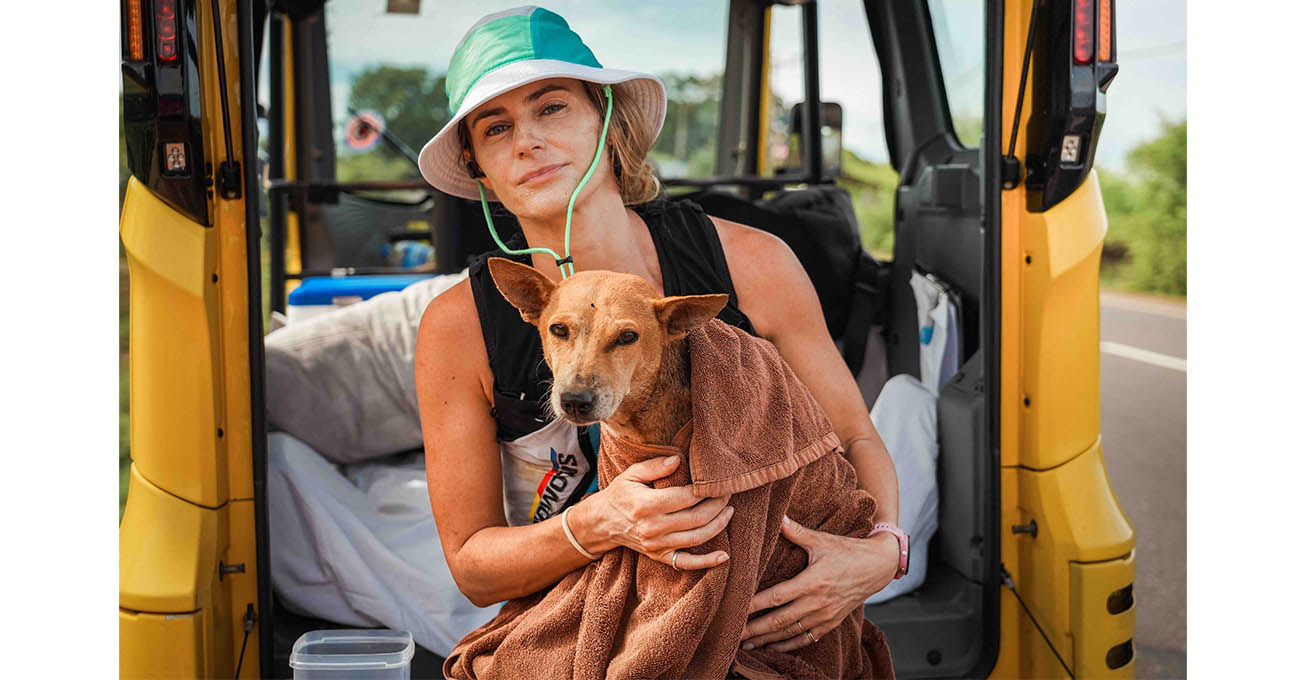
Dr Janey Lowes’ fundraising run across Sri Lanka has raised over £100,000 with the rescue of injured street dog Sarnie showing exactly why she is taking on the challenge.
A last-minute warning about elephant attacks led veterinary surgeon Dr Janey Lowes from Barnard Castle, County Durham in the northeast of England to a paralysed street dog who was struggling to survive beside a road.
Janey was on day five of the Dog Jog, her approximately 600 km fundraising run across Sri Lanka, when local police warned the team that their intended route was unsafe.
They diverted onto a main road. There, they came across a painfully thin dog who did not move as their support tuk-tuk approached.
For Janey, that was the warning sign.
She stopped to examine the dog and found that she couldn’t use her back legs. Scuffs and marks on her body suggested she had been struck by a vehicle some time before.
The team named her Sarnie after her love of the cheese sandwiches they shared with her.
Unable to move out of the path of traffic or reach enough food, she faced a desperate future without help. Nearby residents could not identify her, and nobody the team spoke to claimed her.
With no suitable veterinary care available locally, Janey and her team decided to take her with them and snuck her into their hotel room to provide life-saving care.
The rescue brings home the purpose of the Dog Jog: helping street dogs receive treatment that would otherwise be beyond their reach.
By 26 October, Janey had completed 16 of the challenge’s 22 stages, covering 432 km with 168 km remaining. Supporters have donated over £100,000 towards a new veterinary hospital, rehabilitation centre and training facility for her charity, WECare Worldwide, but there’s still a long way to go before the £1.5 million target is reached.
Dr Janey Lowes said: “If we hadn’t changed our route and serendipity hadn’t played its part that morning, we would never have found Sarnie. What caught my attention was that she didn’t move when our tuk-tuk approached. Most street dogs would get out of the way, but she couldn’t.
“She was so thin, and she couldn’t use her back legs. Leaving her there would have meant leaving her unable to find food or get away from traffic. We couldn’t walk away.
“I’m tired, my feet hurt, and there are days when the distance ahead feels enormous. Then you meet a dog like Sarnie and you remember why you’re doing it.
“We can’t promise how her story will end, but we’ve given her a chance. She has food, comfort and a team caring for her. Getting help shouldn’t depend on a vet happening to pass along the right road.”
With hospital care far away, the team took Sarnie into their hotel room, giving her food, water and somewhere safe to rest.
American volunteer Chrisi, an experienced foster carer for dogs, helped look after her while the team arranged transport to WECare’s hospital in southern Sri Lanka.
As Sarnie ate, drank and received care, the team began to see encouraging changes. They then organised the long drive south so she could receive further veterinary assessment and treatment.
Her rescue highlights the difficulties of reaching injured street animals in areas where suitable veterinary care is scarce.
Janey, who founded WECare in 2014, is running from Point Pedro in the north to Dondra in the south, facing heat, humidity, blisters and exhaustion along the way.
She is undertaking the Dog Jog to help fund a larger hospital, rehabilitation centre and veterinary training facility. WECare’s existing hospital provides round-the-clock care for street dogs, but demand has outgrown its facilities.
The new centre would allow the charity to treat more animals and train veterinary professionals, extending the impact of its work.
For Sarnie, a warning about elephants, a changed route and a vet who noticed something wrong brought help when she needed it.
She now has care, comfort and a chance.
Support the Dog Jog and help WECare reach more dogs like Sarnie: https://www.justgiving.com/page/janeysdogjog.
Follow the Dog Jog: https://www.thedogjog.co.uk/.