

As millions around the world watched the Artemis II countdown with anticipation usually reserved for major sporting finals or cultural events, academics based at Space Park Leicester say the extraordinary public response reveals something bigger than a return mission to the Moon.
The launch has reignited a global emotional connection with human spaceflight, one that researchers at the University of Leicester’s newly established Leverhulme Centre for Humanity and Space believe deserves far greater attention as humanity enters a new era of exploration beyond Earth.
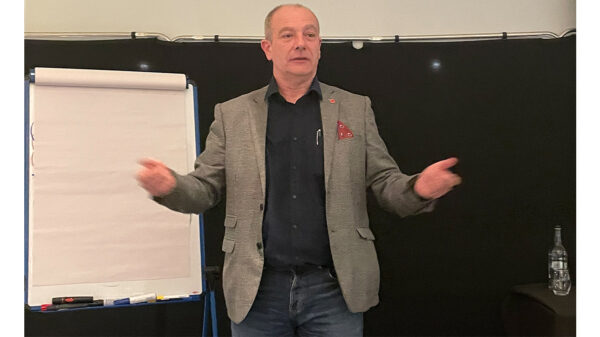
Eventually with more than 18 million viewers watching the mission unfold on NASA’s YouTube Channel and thousands of spectators gathered at Cape Canaveral on launch, Dr James Aitcheson, one of seven newly appointed postdoctoral Research Associates at the Centre, says the scenes surrounding Artemis II highlighted how spaceflight continues to hold a unique power over people across generations, cultures and nations.
While many discussions around space focus on technology, engineering and economics, Dr Aitcheson argues that the overwhelming public fascination with Artemis II demonstrates the importance of understanding the cultural and human dimensions of space exploration.
Watching the launch unfold, he was struck not simply by the rocket or the astronauts, but by the thousands who gathered in person and the millions who tuned in online to witness the moment together.
He said: “The crowd shots told a different story, as they panned across adults and children alike beaming with giddy delight. The scene as a whole resembled a cross between a religious service and a music festival.”
That response, he says, reveals how deeply space exploration connects to questions of identity, aspiration and humanity’s place in the universe.
“At a time when Artemis is taking humans back towards the Moon, we also need to ask why these missions matter so much to people,” Dr Aitcheson noted.
He added: “Spaceflight clearly means something to a lot of people around the world. The notion of people like us heading out into the wider universe presents a profound challenge to how we perceive our place in the universe.”
Based at Space Park Leicester, the University of Leicester’s £100 million hub of space research and innovation, the Leverhulme Centre for Humanity and Space has been established to explore the political, social, ethical and cultural impact of humanity’s growing presence in space.
Backed by a 10-year and £10 million investment from the Leverhulme Trust, the interdisciplinary centre will create 42 new research positions at the University in the fields of social science, arts and humanities to examine how humanity’s relationship with space is evolving.
Its researchers will explore how people can live and work in space fairly, sustainably and peacefully, while examining how space is governed, communicated and understood by society.
For Dr Aitcheson, whose research explores medieval astronomy and representations of space in contemporary literature, the excitement surrounding Artemis II demonstrates why these conversations are urgently needed now.
He stated: “Even though spaceflight might still be the preserve of national space agencies, corporations and billionaires, space itself is something that we all have a stake in. The skies belong to no one, and they belong to everyone.”
Launched in February 2026, the Leverhulme Centre for Humanity and Space comes at a pivotal moment for the global space sector, as renewed lunar ambitions, commercial spaceflight and international competition reshape humanity’s future beyond Earth. Researchers at Space Park Leicester believe understanding the human response to this new space age will be just as important as the technological advances driving it.
Dr Aitcheson concluded: “Homo sapiens is still very much in its infancy as a spacefaring species, our attitudes towards space are fast evolving. As we start to venture further, how will they continue to evolve? That’s one of the questions we at the Leverhulme Centre are trying to answer.”
To explore Space Park Leicester partnerships, missions, residents, facilities, training programmes and innovation products, visit https://www.space-park.co.uk or to learn more about the University of Leicester, visit https://le.ac.uk/.