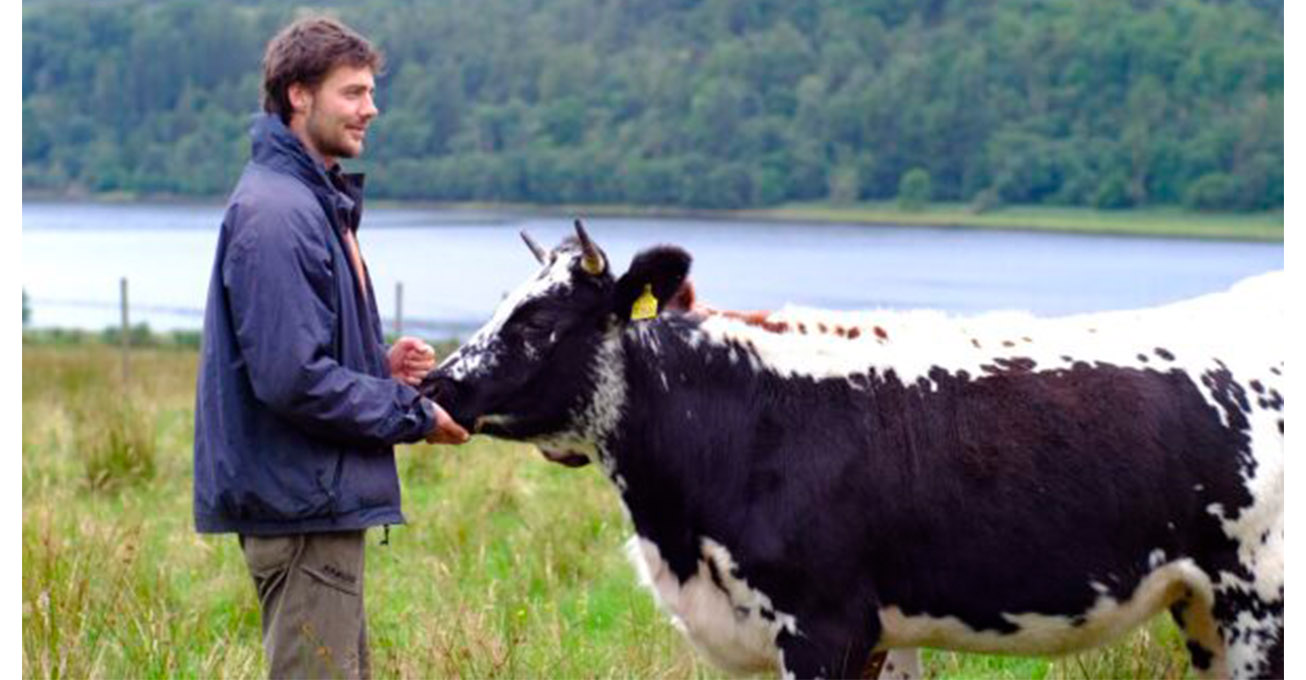
An endangered Irish cattle breed has been introduced to Scotland for the first time in centuries to help restore native woodland as part of a sustainable land project on a remote West Coast estate.
Twelve Droimeann cattle have arrived at Ardtornish, where they will work across rainforest, scrub and rough grazing.
The ancient breed’s role is to break up dense bracken, manage coarse grasses and help create the conditions for a wider range of plants and habitats to recover, while forming the beginnings of a working herd that can produce food.
The arrival – due to be featured on BBC Scotland’s Landward programme on October 22nd – is a new step in Ardtornish’s long-term effort to restore land shaped by generations of heavy sheep and deer grazing.
The estate has already reduced grazing pressure and created native woodland. The cattle will add a different kind of impact, directed to places where their grazing, browsing and movement can help the land recover.
Droimeann cattle have a rich history in Irish folklore, with written records going back over 1,000 years; they were once widespread in Ireland but became rare as farming moved towards more specialised breeds.
They are intelligent animals able to forage across varied ground, including the woodland and scrub at Ardtornish.
The Irish Government recognised the Droimeann as a native rare breed in 2020.
Hugh Raven, managing director of Ardtornish estate, said: “For generations, this landscape has been shaped by large numbers of sheep and deer. Renewing it will take more than planting trees. We need the right animals, in the right places, helping natural processes return while people continue to farm and produce food here. Bringing Droimeann cattle to Ardtornish is an important step in that work.”
The project is led by Alec Heywood, farming partner at Ardtornish, who has studied the breed and arranged for the cattle to be brought from Ireland.
The herd includes several of the breed’s colour patterns, including animals with the pale stripe along the back from which the Droimeann takes its name. Old Scots Gaelic milking songs celebrate the different colour patterns found in this breed and old texts lament their disappearance from Highland Scotland. Ardtornish plans to establish a breeding herd once it has found genetically suitable bulls.
Alec Heywood said: “These cattle are remarkably good at finding food across woodland, scrub and rough ground. That makes them valuable partners in the work we want to do here. We can use them to break up dense bracken, graze areas that need careful management and help make room for a richer range of plants. I also want the project to produce good organic food as the land recovers.”
The cattle came from the herds of Irish farmer Tom Keane, who has worked alongside other breeders and the Droimeann Cattle Society to preserve and rebuild the breed, and fellow farmer Anthony MacNamara.
Tom farms beside the Shannon Estuary in West Limerick, where he has a herd of around 70 Droimeann. He and his brother Michael began keeping the cattle in 2001 and joined other breeders working to preserve the breed and establish its herd book. Their farming has also earned them recognition as Farming for Nature ambassadors.
Tom Keane said: “A great many people have worked to keep the Droimeann going and build its numbers. Seeing a herd establish itself in Scotland is encouraging for the breed and great for Ardtornish.
“It spreads those precious bloodlines to another country, promotes the shared cultural connection that these cattle can foster, and gives the Droimeann a role doing what hardy, adaptable animals do well: living on the land and helping to manage it.”
Ardtornish will follow the cattle’s impact across different habitats as the project develops, aiming to show how nature recovery and food production can work together on the same land.