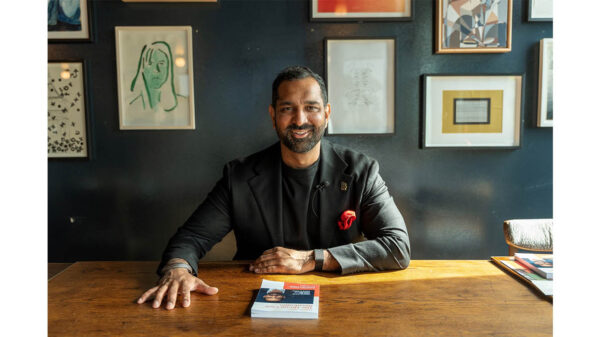


Tell us about Social-Ability and what the company does.
Social-Ability is a social venture with an ambition to make society happier. Our first goal is to spark laughter and happiness for everyone living with cognitive challenges, such as dementia or learning disabilities, as well as people in primary care settings. We do this with our Happiness Programme, which combines our interactive light projection technology with a structured implementation framework to help ensure effective training for staff on its use.
Over the past few years, we’ve worked with many of the top care home groups in the UK and Ireland, as well as with many libraries, NHS Trusts, hospitals and community centres.
We’re borne out of a genuine desire to tackle the challenges faced by those with dementia in their lives – of which many of our team have had first-hand experience. We started with a simple idea – to listen to the many care staff, friends and family that we’d met and worked with to develop something truly ground-breaking: best-in-class light projection technology paired with a service offering so powerful that we were willing to guarantee its effectiveness.
With a background in law, what was the inspiration behind joining Social-Ability?
I started my career as a corporate lawyer at Linklaters, living the fast-paced lifestyle that comes with working at a Magic Circle law firm. But I was also influenced heavily as a teenager by a decade of experiencing dementia in my family. So, I decided to switch careers, co-founding the start-up Shift8 in 2016, which specialised in interactive light activities for people with dementia and rapidly became the market leader within the industry.
I had some time away to start a family, but was ultimately pulled back by my passion for improving people’s experience in health and social care settings. Ultimately, at Social-Ability, our motivation comes from experiences of living with dementia in our families – mine included.
How does Social-Ability benefit people who are living with dementia?
In so many ways.
Lockdown has had acute mental health impacts for people living with dementia. 56% of people living with the condition have reported feeling completely isolated since the beginning of the pandemic, while a third of respondents also ‘felt like giving up’ last year.
But loneliness is not simply a “pandemic problem”. A dementia diagnosis can also be a really isolating experience in itself and, even prior to the pandemic, over a third of people living with the condition said they had felt lonely, while a third also said that they had lost friends following a diagnosis.
The Happiness Programme works to break down barriers to connection and address the serious loneliness that people too often experience alongside dementia – helping people to reconnect with their families and build relationships with those who support them, especially in care homes.
As human beings, we all thrive on connections – regardless of our age. This is something I have seen first-hand through our work with Alexandra Grange, a Hallmark care home in Berkshire, where staff supported one resident to use interactive light projections on her bed and play a game where she burst bubbles with her grandchildren.
Through the Happiness Programme, she was able to rebuild the vocabulary to communicate with her family, as well as her support workers. But it also had real benefits for her holistic wellbeing. Interactive technology such as this has been proven to improve the condition of people living with all stages of dementia and, by playing with the interactive ahead of meal times, it also supported important weight gain for this individual.
Are there any benefits for the healthcare system of introducing schemes like the Happiness Programme?
Over-medication is a crucial issue for people’s wellbeing and something that the NHS is already trying to address through its Long Term Plan. Technology such as the Happiness Programme can play a central role in reducing unnecessary dependency on medication, which in turn can alleviate pressures on a healthcare system under increased strain from Covid-19.
In fact, even prior to the pandemic older people spent around two million days in hospital each year and accounted for about 250,000 emergency hospital admissions. However, some 35%-40% of these admissions are thought to be avoidable through actions such as tackling over medication for long-term conditions – including dementia. Further, care home residents are prescribed an average of seven medicines a day, with many taking 10 or more, costing the NHS an estimated £250 million each year.
Following reports this week that as many as one in 10 new dementia cases may have missed diagnosis during the pandemic so far, now is a watershed for NHS Trusts and elderly care providers to invest in therapeutic interventions – such as interactive light technology – that reduce over-medication, support weight gain and, most importantly, foster connections between people living with dementia and their support networks. If care homes do the same, we can truly begin to reduce the financial burden that over-medication places on our NHS and healthcare system.
Companies such as Social-Ability are bringing new tech-led approaches to therapeutic interventions. What do you think is next for technology in the social care sector?
Technology has had such an important part to play in helping people to overcome loneliness. We need only look at our dependence on technology such as FaceTime, Zoom and video calls in lockdown to see that with crystal clarity.
But the fact is that technology doesn’t just work on its own. It’s a tool, not an end goal.
For sustained and effective use, training and support is essential. Staff need to be supported to use it consistently as part of a whole care home approach that benefits all residents. This is something we really try and focus on with the Happiness Programme and why I’m passionate about building long-term partnerships that empower staff to use our technology effectively.
In terms of what’s next for technology in social care, I hope it’s seeing this training-led approach become the mainstream attitude around technology adoption.
What does lockdown easing mean for Social-Ability and the care homes you support?
The ending of restrictions and reopening of the economy is a momentous moment for so many sectors. However, for care homes and the older people they support – especially those already experiencing loneliness around dementia and the health impacts that can come with this – lockdown easing is far from a silver bullet. But it could be a watershed moment in how care homes approach and invest in the wellbeing of people they support, creating happy memories and easing loneliness.
I hope care home providers will see the Happiness Programme as an important step towards those goals.