

By Ian Strachan.
Replacing the iconic Land Rover Defender – a firm favourite with everyone from farmers and soldiers to explorers and landowners for more than 70 years – was never going to be easy.
This was a vehicle beloved of even the Royal Family, so the task of redesigning it dripped with heavy responsibility. But those clever people at Land Rover have pulled it off. The result is an attractively-designed uber-capable son of Land Rover. A true and worthy offspring of its venerated parentage.
The new Defender has all of the virtues of the original – sturdy, purposeful design, triple seats across the front, plenty of load-space, a commanding driving position and of course its peerless off-road capability. The negatives of the original have been eliminated so you get comfortable seats that don’t force you to sit bolt upright, the engine noise doesn’t require ear defenders and you get every modern convenience you’d expect in a 21st century SUV. The air conditioning doesn’t involve opening the front vents and the window wipers even have their own motor!!
OK so it’s a lot more expensive than the model it replaced, but for this amount of car with a Land Rover badge there’s a price to pay.
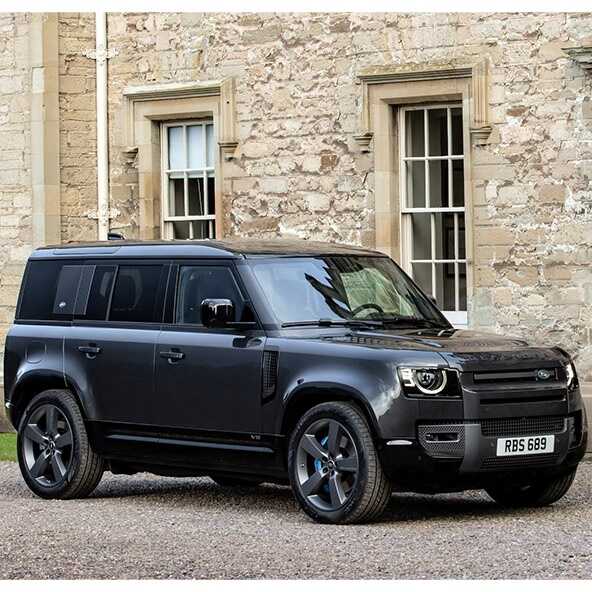
I road tested the excellent Defender 110 D250 automatic with a 250 bhp three-litre diesel engine. While it is undoubtedly a Defender it has smooth, more rounded lines which give it better aerodynamics. For all its qualities, its predecessor had the aerodynamic properties of a garden shed.
Inside and out, the Defender is a pleasing vehicle. Its distinctive shape, statuesque road presence, purposeful front end, big 18-inch wheels with a full-size spare wheel and high quality interior make it a good looking vehicle.
It has the ultimate in capability off road but is exceptionally well behaved on road. As well as being an unexpectedly superb motorway cruiser the Defender can still handle the rough stuff better than anything else. It is a Land Rover after all.
The 3.0 litre 250hp diesel engine has plenty of guts, delivering power throughout the range without ever feeling reluctant to propel this big car. It’s quiet and smooth running with a 0-60mph time of less than eight seconds, which would have been a distant dream in its predecessor. The automatic gearbox is exceptionally flexible. It’s not exactly frugal when it comes to fuel consumption but you wouldn’t expect it to be. You can still average 30 miles to the gallon if you’re not too heavey-footed.
Handling is stable and predictable, with no suspension wallow, and flat cornering. On road its manners are impeccable and steering is light but precise.
Specification is very good and includes heated, electric folding door mirrors with approach lights and puddle lights, all-season tyres on 18-inch steel wheels, a twin-speed transfer box, terrain response, air suspension, eight-way heated and powered grained leather front seats, satellite navigation with a 10-inch screen, smartphone connectivity, 180W sound system with six-speakers, wade sensing, 360 degree parking aid with 3D surround camera, cruise control with speed limiter and traffic sign recognition.
The S specification which I tested also comes with LED headlights with high beam assist, 19-inch six-spoke wheels, leather steering wheel, a centre console and armrest on the back of the fold-down middle seat, and interactive driver display.
My test car came with a wide range of options including very attractive Eiger grey metallic paint (£895) with a satin protective film (£3,775), black contrast roof (£900), an uprated sound system (£600), a sliding panoramic sunroof (£1,650), privacy glass (£490), off-road tyres (£255), and a towing pack with electrically deployable tow bar and terrain response (£2,200)
The Defender 110 doesn’t come cheap. The model I tested will cost you £66,015 on the road with all the options and £52,985 without them. But it has the indefinable quality and solidity that only Land Rover seems able to achieve in its off-roaders. Money well-spent.