
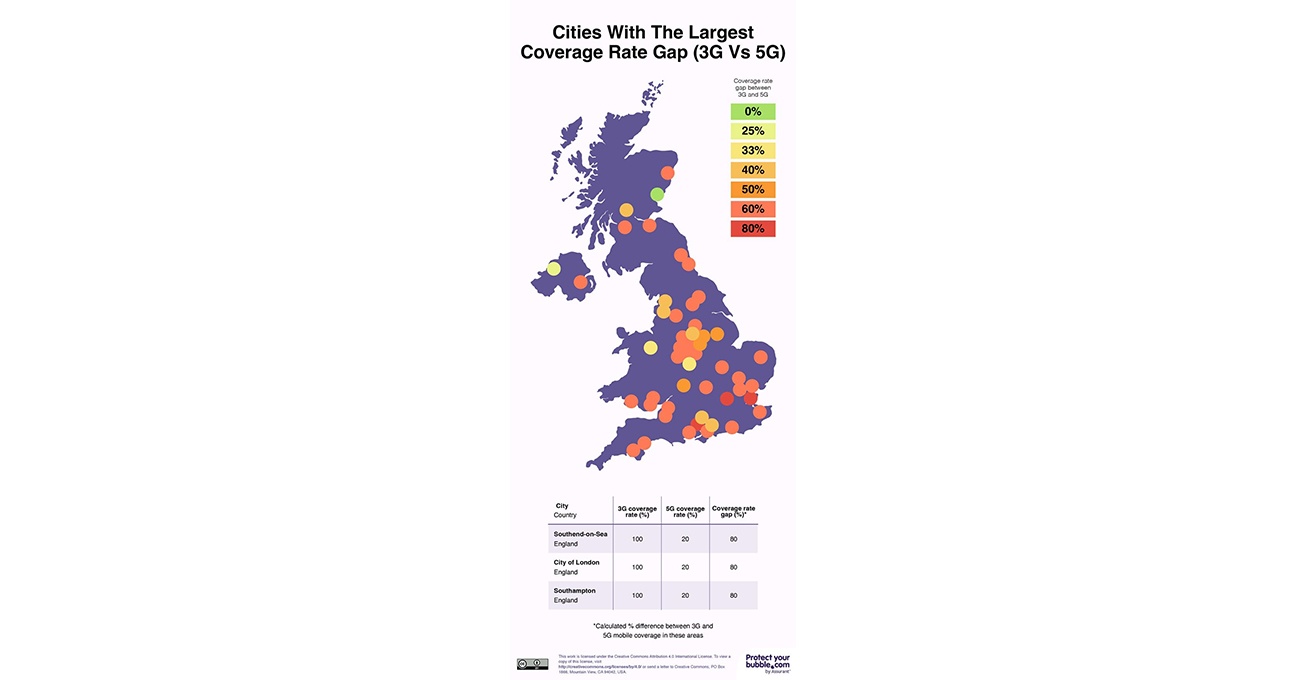

- City of London, Southend-on-Sea, and Southampton are the cities with the largest coverage gap.
- 33 out of 50 cities in the study rely on 3G over 5G.
- Dundee City is the least reliant on 3G coverage.
It is no secret that the United Kingdom is lagging behind other G7 countries when it comes to the desired 5G offering.
A recent report has shared that the UK ranks 30th out of 39 countries for 5G availability, and 37thfor the quality of the 5G.
Many feel the frustration of these figures and have turned to social media to voice their experiences.
Despite users’ voicing their frustrations on social media, providers have started switching off their 3G network, with Vodafone and EE completing their switch-off already, and O2 carrying out their switch-off throughout 2025.
To determine whether the data backs up the experiences of thousands, home and gadget insurance company Protect Your Bubble conducted a study to reveal which cities in the United Kingdom have the largest coverage rate gap between 3G and 5G.
Research was conducted to calculate the percentage difference between the average coverage between these two networks to find out the cities that still have a long way to go for 5G reliability.
The results may come as shocking to most, despite hundreds of millions of pounds of investment across the board to date.
Out of the 50 cities studied, City of London, Southend-on-Sea and Southampton have all featured at the top of the list for the largest coverage gap between 3G and 5G.
These locations have a 100 percent coverage rate with 3G, however, only an average of 20 percent for 5G. Outdoors, each of these cities rely on 3G 80 percent of the time.
Residents in the City of London may resonate with this experience, as many network providers struggle to install the telephone masts that enable you to send a WhatsApp, check your email or refresh your social media apps while on the go.
Despite these challenges, City of London has received a range of investment, including one of 19 cities receiving part of £88 million from the Government.
The second-worst city for connectivity, Southend-on-Sea accommodates over 7 million tourists a year, being the nearest seaside resort to London. However, those expecting to relax on the beautiful beaches and the fun-filled Pier Bay may have some frustrations, as the current infrastructure doesn’t appear to provide5G connectivity in many areas.
Despite 5G being an important conversation in the SE2050 discussions, the expected ultrafast, low latency, and more reliable mobile connectivity, from this plan, does not seem to be developing at the speed the area has hoped for.
Southampton is the third city, rounding up the three-way tie for worst connectivity. While it raised £21.5 million in funding to support the improvements in operations of its port, coverage for the rest of the city seems to be lagging.
Southampton Council has recognised the importance of 5G infrastructure, however, with 3G being phased out, the timeframe could be more crucial than expected.
The study also revealed that 33 out of 50 cities in the study are relying on 3G over 5G 60 percent of the time.
This includes cities in England such as Manchester, Bath and Bristol, as well as the Capital of Northern Ireland and the Capital of Wales.
Some of the investments into improving 5G connectivity include almost £150 million from the UK Government, as well as Virgin Media O2 announcing a £700 million investment in 4G and 5G upgrades, announced earlier in 2025.
At the other end of the spectrum, the research also revealed some cities which rely much less on 3G over 5G.
In England, these include the likes of Worcester and Wrexham with only a 33 percent reliance on 3G over 5G outdoors, whilst in Northern Ireland, Derry City and Strabane has only a 25 percent reliance, making it the second least dependent city on 3G over 5G of our study.
However, there is one city which stood out with an impressive 0 percent reliance on 3G over 5G outdoors in Scotland, Dundee City.
Dundee City has received a £2 million funding from the Scottish Government to invest in digital connectivity, which was secured in 2016, and since then, the city has seemingly been dedicated to delivering excellent 5G connectivity.
Investments by EE have been announced to continue improving the network of the city.
Please click here to see the full study.
James Brown, Director at Protect Your Bubble, commented: “Our study shows that despite millions being spent on improving mobile infrastructure, the UK still has some improvements to be made.
“In selected cities, everyday mobile users could still experience slower speeds and dropped connection whilst trying to stay connected on the go.
“With network providers switching off 3G entirely, consumers are encouraged to check their mobile devices’ compatibility with 5G so the transition can be as smooth as possible.”